|
Adelbert Marvin Scriber was the first child and
son of John Eli and Mary Esther Purvis Scriber. He was born
on January 5, 1864 in Livingston Manor, NY. Occupation: Editor and
Publisher of The Republican Watchman. Education: self educated.
Religion: Methodist.
After
Adelbert's father sold his farm the family moved to Parksville NY where
his father operated a general store. When only five years old, on his
very first day of school, Adelbert attempted to climb onto an
ox-drawn wagon filled with sand, to hitch a ride to school, as was
commonly done by boys in those days. His foot caught in the spoke
of the wheel, which he was using to hoist himself up, and the cart began
to move, dragging him and twisting his leg around and around. The wagon
was finally stopped by a man named George Mitchell, who had a combined
furniture and undertaking business on a near-by corner. In later years
Adelbert said at this point he was "pretty near ready for George
Mitchell's undertaking shop"!
His
father, whose store was nearby, came running and applied a tourniquet.
Evidently there were no doctors in this tiny village so two riders set
out on horseback to neighboring villages. One headed to Liberty
which was five miles away and the other to Rockland, fourteen miles
distant. Adelbert was taken to his home to wait. First to
arrive by horse and buggy were Dr. Watkins and Dr. Webster of
Liberty. Dr. Tuttle of Rockland eventually arrived on the scene as
well.
His
leg could not be saved so was amputated just below the knee. During his
recovery a local man known for his highly exaggerated regional tales of
lore, Johnny Darling, entertained him with these stories. Those were
later told by A.M., as he was called, to his grandchildren.
Many years later a collection of Johnny Darling's stories was
eventually published by an author named M. Jagendorf and A.M. Scriber is
credited in this book as a contributor.
Many
of the residents of the area took a special interest in this young boy
who had suffered an undeserved accident. One in particular was the
attorney, Peter B. Akens, who felt that Adelbert had the makings of a
fine lawyer. Adelbert was in the debating club in high school and
participated in one to two debates per week at which Mr. Akens was
generally present. Adelbert later said that he would either
"condemn or compliment me" but often helped him find sources
for his material. Mr. Akens had intended for Adelbert to join his law
office once he had graduated from school.
Adelbert
said that at that point in time he knew of four lawyers who were
spending their last days in the poor house and he didn't want to be the
fifth. The profession of law was not all that prosperous in those days.
During his high school days Adelbert was writing articles on local
happenings for the Jeffersonville Record. Then a new newspaper
called The Willowemoc Times was established in Livingston Manor
by Moses H. Pride and Adelbert was offered the opportunity to write for
this paper. He went to their office
twice a day, before and after school, and did a variety of other
jobs there as well.
It
may have been during this period in time that Adelbert purchased, or
built, a house in Livingston Manor. An article in the July 20 1888 Sullivan
County Record states: “The
carpenters have commenced work on D.M. Scriber’s new house. They will
soon be ready to raise it.”
Adelbert was often referred to as Del, therefore “D.M. Scriber”
would have been him.
Over
time Del decided that he really enjoyed newspaper work and gave up the
idea of law altogether. By the time he was sixteen he was the editor and
proprietor of his own little newspaper called The Livingston Manor
Times. He was said to have been the youngest editor in New York
State at that time. After
doing this for two years he sold it and joined the staff of The Homer
Republican in the town of Homer NY. He boarded at the Homer Hotel
while there.
After
being there nearly one year he came home for a vacation and was invited
to Monticello by Mr. Barnum who was the editor of The Republican
Watchman. Mr. Barnum needed additional help on the printing of a law
case of five or six hundred pages (The Bethel Appeal Case). Monticello
was twenty-five miles away and Adelbert, although eighteen years old,
had never been there before. It was quite a distance to go by horse, so
he took the train from Livingston Manor to Fallsburgh and the mailman
brought him to Monticello via horse and wagon.
He
agreed to help Mr. Barnum during his four week vacation. In the four
weeks that Adelbert was in Monticello, he was very taken with the charm
of the village and the friendliness and kindness of its people. He made
a decision that he would not return to Homer and since there was still
much to do for Mr. Barnum, told him that he would stay on until this
work was completed. He took on additional projects of hand-setting the
type for the printing of the laws of New York State, which were to be
published in the Republican Watchman and at night he went over to
another newspaper, the Sullivan County Republican, where he
helped set up some laws for their printing.
Mr.
Barnum came to Adelbert one day and said that his foreman, Frank Holmes
was not well and was taking a leave of absence, and asked if Adelbert
could fill in as his "assistant" for nine dollars a week,
which was one dollar less than Mr. Holmes was paid. In these days this was considered a large salary for a
printer. Adelbert agreed to this and received instructions from Mr.
Holmes on how to care for the
cylinder and job presses and the other work that he would be responsible
for. Within two weeks Mr. Holmes was dead.
Shortly
after the funeral, Mr. Barnum offered Adelbert the job as foreman for
ten dollars a week and he accepted. Ten dollars went a long way in those
days. Adelbert boarded at the Dutcher house which was adjacent to the
Methodist Church on Broadway and board was only three dollars a week
which included ham, eggs, chicken, a lovely room and comfortable bed.
Later
his brother, Bert, also came to Monticello and they shared the room for
seven years. Later they moved to the Ennis house, kept by Mrs. Charles
Ennis. After her husband, who was had been Deputy County Clerk, had
become paralyzed in his lower extremities, she opened a rooming house to
generate some income. The Ennis' daughter Grace, had a spectacular
soprano voice. Their two
sons also had fine voices and Adelbert had wonderful memories of much
music and singing in this household.
Eventually
his mother and sister, Caroline came to Monticello and moved into a
house on Clinton Avenue which they then shared with Adelbert and Bert.
With some of the money that he saved he decided to purchase a three
story house in Livingston Manor. It is not known just why he did this.
Possibly he had the idea of eventually moving back there or saw it as an
investment and rented out rooms there.
In
1895 he was offered a half-interest in the newspaper. Unknown to all at
that time was the fact that Mr. Barnum did not own the newspaper, but it
was owned by Judge George
Beebe, and he now intended to sell it.
Judge Beebe wanted a down payment of one thousand dollars,
meaning that Mr. Barnum and Adelbert would have to each put in five
hundred dollars. Adelbert's salary had by then increased to eleven
dollars and fifty cents per week and he had managed to save only a total
of about thirty dollars by then in that he had purchased the Livingston
Manor house. His only hope was to borrow the money. After making some
inquiries he heard that a local hardware clerk, John Armstrong, had sold
his property and now had two thousand dollars to invest. By the time
Adelbert reached him though he had just loaned seventeen hundred of this
to someone else and had only three hundred of it left. Adelbert left
thinking that that just wouldn't do but shortly returned deciding that
three hundred was not too far from the total necessary. Mr. Armstrong
said that collateral was unnecessary but they did agree to have Dr.
Cauthers endorse the loan for him. Adelbert left with the three hundred
dollars in his pocket wondering how he would get another one hundred and
seventy-five to add to his own meager twenty-five.
He
then heard that "Old Uncle Jimmy Geraghty", who was a friend,
had some money to loan. He and his brother, Bert, went by horseback to
Geraghty's home that evening. Uncle
Jimmy answered the door and was delighted to see them, offering them
cider and apples. After some cider, apples and chit-chat, Adelbert told
him about his agreeing to purchase the half-interest and his need for
the money. Uncle Jimmy said he could have it and even more if he wanted
it. He went to a cupboard and removed some dishes and dug around in the
recesses coming out with a handful of bills. After counting it though
found he was a bit short, so went upstairs and came back with the
additional needed. Adelbert was able to pay back Uncle Jimmy within a
year but Mr. Armstrong let his note run on for three or four years until
he was ready to build.
The
actual story of his meeting his future bride is unknown, but she and her
sisters owned and operated a big Victorian boarding house on West
Broadway. On April 6, 1899 they were married at this house, called
“The Osborn”. The story of their wedding was in the local papers.
The couple honeymooned in Boston and on their return lived for a while
with his mother, sister and brother on Clinton Avenue. In about 1902,
Adelbert purchased a house right next to the Osborn house from William
I. Stewart. This house was one of the earlier houses of the village and
probably built in the early 1800s. It was quite small so Adelbert added
on to the original structure with a front parlor and large front porch
which curved around to the side. This was later enclosed and became a
sun-parlor. Front bedrooms were added and another set of stairs leading
up to the front area of the house. In all it had thirteen rooms,
counting the walk-in pantry, vestibule, sun-parlor, library and dressing
room. In the early days there was no electricity or running water. The
house was lighted by kerosene lamps and lanterns and a beautiful
cranberry glass hanging lamp, given to them as a wedding gift, hung in
the front entry. In those days there were chamber pots under the beds
for night-time "urgencies" and during the day one used the
outhouse. Water was piped up from a well with a pump in the kitchen. The
house was situated on a knoll slightly raised from the wide unpaved
street (at that time called Main St.) and behind it stood a barn with a
hay loft. When Adelbert and his bride moved to this house his mother and
sister came along as well. Their three children were literally born
there and also a fourth, a son, who
died of an intestinal aliment when still an infant.
Life
was good and Adelbert was doing well. He and his wife were involved in
the community and highly respected. In addition to being a newspaper
editor he was writing some historical fiction. He published his own
novel in 1906, based on the Battle of Minisink, entitled "Old
Jed" and completed another entitled, "Deacon Davey",
which never was published.
Adelbert
had an artificial leg which was molded of metal and painted flesh color.
His stump slid into the hollow and it was strapped on . He walked a bit
stiffly, always with a cane.
In
the spring of 1909 Mr. Barnum died at his farm east of Monticello.
Adelbert remembered him as a very generous man. On occasion he would
hand Adelbert an extra twenty dollars as a bonus for a job well done, or
a turkey at Thanksgiving. As a wedding gift he gave the newly weds a set
of dishes worth seventy-five dollars, which according to Adelbert, was a
tremendous price in those days. Adelbert reminisced with great pride
that he was worthy of being a business partner of the likes of George
Barnum. Mr. Barnum had been a court stenographer and one of the first to
learn short-hand. He had been offered a professorship in astronomy at
the University of Chicago in the 1870s because of his incredibly
accurate tracing of a comet. The newspapers had reported his work and he
received a great deal of publicity.
Only
six months after Mr. Barnum's death a fire broke out in the newspaper
office which was in the brick Masonic building in Monticello. The files
were carried out to the lawn of the adjacent courthouse and thus saved.
Two years later Adelbert bought out the Barnum interest of the business
and paid the heirs fifty-five hundred dollars and assumed the
indebtedness for the new presses and equipment that were replaced after
the fire. He also gave Barnum's widow one thousand of the insurance
money for the loss of the plant, making him now sole owner. Later
Adelbert built a new building to house this business on what was the old
Waller property, a block
long, and which Adelbert now owned. The post office was also on this
piece of property. The business grew and included a Webb, Book, and
three job presses as well as three linotype machines.
Adelbert
became quite active in politics and held various offices over the years.
He was secretary, treasurer and chairman of the State Democratic
Committee all at the same time due to the simultaneous resignation of
these officers who refused to support Hearst, who was running for
Governor. This put him in a very responsible and laborious position
which he upheld for a year and then also resigned. Often he contributed
large sums of money from his own pocket to help promote candidates.
He
was a member of the Methodist Episcopal Church in Monticello NY and
licensed to preach. He was also a member of the school board, on the
board of Education, served twelve years on the Water Board and was
Deputy Grand Master of the Odd Fellows Lodge in Monticello.
In 1930 he was appointed by FDR, then Governor of New York, as a
member of the Washington Memorial Commission of New York State. He was
also the President of the Sullivan County Historical Society that same
year. It appears that he gave greatly both physically and monetarily to
his community. As adults his children always said that he could have
been a very wealthy man but he gave to people who were needy never
expecting to be paid back and always was contributing to various causes.
He
sent all of his children to college. His daughters both went to New
Paltz Normal School, then a two year teacher's college, now SUNY New
Paltz, and his son went to Lehigh in PA.
Early
in his newspaper career he became an acquaintance of Franklin Delano
Roosevelt and in supporting him politically from
Secretary of the Navy on to Senator, Governor and to President of
the United States continued a regular ongoing correspondence with him
throughout his entire adult life. A collection of these original letters
have been passed on to his heirs and copies of both his and Roosevelt's
letters are on file at the Roosevelt Library in Hyde Park NY.
His
grandson, Robert L. Scriber recalls his father John, telling him how he
used to drive his father, Adelbert, to Hyde Park to meet with Roosevelt.
John would wait outside. On several occasions Adelbert was invited to
lunch with FDR or to meet with him. It appears from the content of the
letters that FDR recognized the influence this country editor could have
on his career.
Adelbert
and his wife, Susan, on occasion would take the train to Albany for
State dinners. Some of Susan's lovely dresses used for such occasions
still exist as do some of the programs and menus from the various
political and organizational dinners that they attended.
During
these good years they owned a summer cottage on Sackett Lake not too far
from Monticello. They called it the "camp". It was a wonderful
place to unwind, canoe, swim or just sit and read on the screened-in
porch overlooking the lake. According to a deed (in the possession of
Susan Schock) this property was purchased in September of 1923 for
$2,300.00 from a Mr. and Mrs. Thomas Ellis of Monticello NY. It was
described as follows: Being
all the land, bungalow and furnishings of bungalow, except as herein set
forth, at Sackett Lake, Sullivan County NY, owned by first party,
bounded easterly by Sackett Lake. southerly by Pelton, Keary and Whelan,
westerly by the Sackett Lake Road and northerly by Keary and Whelan.,
excepting an oak table, one mattress to be selected by vendor, sewing
basket, such china and pictures as vendors select. Being the same
premises conveyed to said Thomas Ellis and wife, by deed dated July 8,
1913 and recorded in Sullivan County Clerk’s Office in Deed book #174
at page 26. Also excepting
trunks and clothing and personal effects of vendors which they bring
with them every spring when coming to the bungalow.
Note:
An Ellis family had settled quite early in the Town of Rockland and it
is thought that there might be a blood link to this family somehow with
the Purvis family (not yet determined).
If so Thomas Ellis may have been a distant cousin of A.M.
Scriber’s.
In
1947, Adelbert underwent surgery in Brooklyn, perhaps for prostate ...
people did not discuss such things then though. In November of 1947 the Middletown
Times Herald published a story about Adelbert with a formal photo of him.
BACK
AT DESK - Sullivan County Editor, 83, Resumes Work on Book Destroyed in
Fire - Monticello - A. M. Scriber, eighty-three, one of New York
State’s oldest active editors, was back at his desk at the Republican
Watchman
office here today after a summer of illness which necessitated two
operations at a Brooklyn Hospital.
Mr,
Scriber has resumed work on two books, manuscripts of which were lost in
a fire December thirteenth 1942. The blaze destroyed the Watchman
building on the south side of Broadway.
At
the time of the fire Mr. Scriber had the manuscript of one book, Fifty
Years a Country Editor wrapped ready to ship to a New York publisher.
The other, a History of Sullivan County was nearly destroyed. He is now
rearranging chapters for that book. He expects to complete the two
volumes within a year.
Mr.
Scriber attended the Democratic National Convention in 1944 as a
delegate-at-large and voted for Frenklin D. Roosevelt and Harry
S. Truman. Also in 1937 he was a presidential elector, casting his
ballot then for Franklin D., Roosevelt for President and John N. Garner
for Vice President.
Mr.
Scriber has been keenly interested in the county and its people. After
the disastrous fire of 1942, the editor and his son-in-law, Alvin O.
Benton, moved across the street and after a great deal of effort resumed
operations in the plant. A press was the only piece of equipment
salvaged. from the fire.
Adelbert
died of heart failure in his sleep never finishing these books. As
of today only one history of Sullivan County was published in 1873 by
James Eldridge Quinlan, a former editor of the same newspaper, The
Republican Watchman. Adelbert’s
obituary was written up in the New York Times on August 14, 1948.
The
following are some newspaper items of interest in Adelbert's life:
In
1930, the Sullivan County
Democrat
reported:
| Adelbert
M. Scriber, editor of the Watchman at Monticello, has just
received notice of appointment by Gov. Roosevelt as a member of
the Washington Memorial Commission of New York State. Mr.
Scriber is president of the Sullivan County Historical Society. |
In
September 1948, a month after
Adelbert’s death, this appeared in the Republican
Watchman:
|
New
Historian
James W. Burbank of Narrowsburgh
County Historian
“The
late Adelbert M. Scriber, publisher
of the Watchman had served in the post for 15 years without
salary.
The
new appointee will be paid $1200 a year.” |
Adelbert Marvin died
in Monticello, NY, on August 13, 1948 at the age of 84. He is
buried in the Orchard Street Cemetery, Livingston Manor NY.
Susan Schock has contributed greatly to her line on
this website. Adelbert Marvin Scriber was her grandfather.
Our thanks to her for her very thorough biography and pictures.
|
Susan
Wilks Osborn was the daughter of Lewis Vultie Osborn and Harriet
Elizabeth Gardner. She was born on October 8, 1867 in Centerville
NY, now Woodridge NY.
Susan
was a talented seamstress and worked in New York City in this occupation
up until 1897, just a year prior to her marriage. She and her sister
Emma were commissioned by wealthy families to custom make clothing for
them. She and her sister designed and made her wedding dress which was
of ecru faille with a shirred chiffon trim. After her marriage she made
many beautiful dresses for herself and her daughters, some of which
still exist and have been handed down .
After
their marriage she and Adelbert lived on Clinton Avenue in Monticello,
with his mother and brother and sister. Soon after, Adelbert purchased a
house at 371 Broadway and at that time his mother and sister moved there
with them. Fortunately their house was large with a living
room, parlor, sun-parlor, library, vestibule, pantry, front and
back stairs and many bedrooms as well as a dressing room upstairs. It
still must have been difficult always having someone there and Susan's
mother -in-law died only one year before she did. In those days when one
died the body was laid out in the home, so Adelbert's mother was
"viewed" by family and friends in the parlor as was Susan a
year later.
Susan
was forty-four years old when her last child was born, a boy, who lived
to be only four months old.
She
was very active in women's groups of the Monticello NY Methodist
Episcopal Church as well as the Women's Christian Temperance Union. She
entered many of her "fancy work" pieces at the Sullivan County
Fair and usually won blue ribbons. Her handiwork was finely and
exquisitely done and displayed much patience, skill, and perfection.
An
notice appeared in the August 8 1924 edition of The Republican
Watchman as follows:
| Mrs.
A.M. Scriber will receive entries for the Ladies Department of
the Sullivan County Fair at her home, 371 Broadway, Tuesday and
Wednesday, Aug. 19 and 20. |
Susan
celebrated her 57th birthday party with a surprise picnic.
The Republican Watchman
reported on October 16, 1924:
|
Mrs.
Scriber’s Big Birthday
“The
ladies of the Methodist Church, comprising the ladies Aid
Society picnicked at the Scriber’s bungalow at Sackett lake
Wednesday. Mrs. Scriber is
president of the Society.
The gathering occurred on her birthday and birthday cakes
graced the tables. The
presentation of a handsome wall painting
by pastor Hoyt to the
hostess was a climax to the dinner. It was a real
enjoyable time in spite of the surprises and in spite of the
fact that the hostess did not know she was to have a birthday
party.” |
A
story was always told of how she and her sister, Nell, built her
children a playhouse behind the boarding house next door which was
operated by her sisters. Susan's husband, being handicapped was unable
to do these sorts of things and so she took it upon herself to carry out
such jobs. Her children had very fond memories of this playhouse and the
wonderful times spent there.
Her
daughter Elizabeth, used to say that she would say:” The dogs have the
days, the cats have the nights ....and your time will come!”
Susan
became ill with a kidney ailment and suffered for a number of years with
this before her death.
She died in Monticello, NY, on June 17, 1933 at the age of 65. She
is buried in Orchard Street Cemetery, Livingston Manor NY.
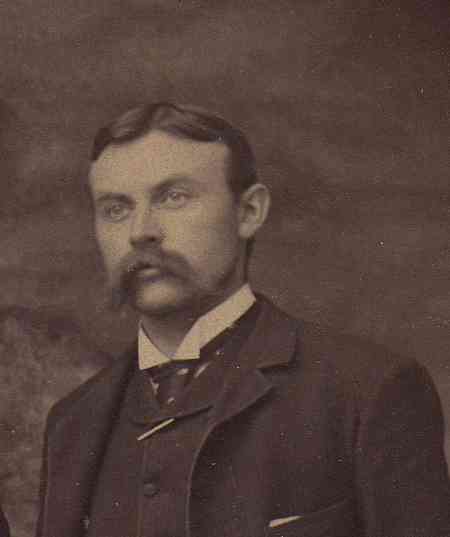
Adelbert M. Scriber, 1864-1948
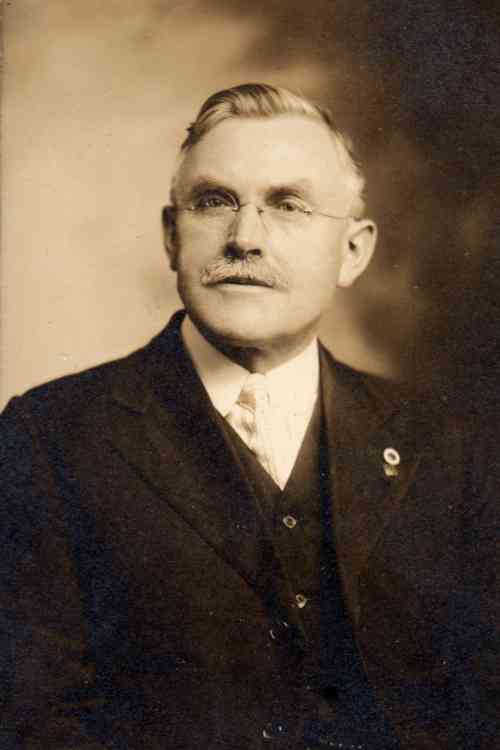
Adelbert M. Scriber, in his later years
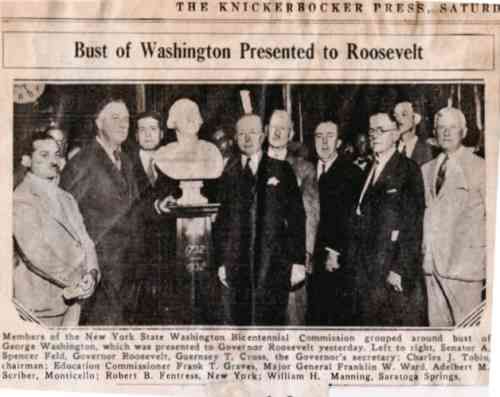
A newspaper clipping provided by Susan Schock. The
caption reads "Members of the New York State Washington
Bicentennial Commission grouped around a bust of George Washington,
which was presented to Governor Roosevelt yesterday. Left to
right, Senator A. Spencer Feld, Governor Roosevelt, Guernsey T. Cross,
the Governor's secretary; Charles J. Tobin, chairman; Education
Commissioner Frank T. Graves, Major General Franklin W. Ward, Adelbert M. Scriber,
Monticello; Robert B. Fentreas, New York; William H. Manning, Saratoga
Springs."
|