|
John Eli Scriber was born on January 8, 1835 in
Rockland (now Livingston Manor), Sullivan County, NY and christened
on September 20, 1825 at the Klyne Esopus Church, Esopus NY. The
baptismal record can be found in the records of the Klyne Esopus Church
#740. John Eli was the third child and second son of Philip William and Polly Wright
Schriver.
Sullivan
County Court House records note that in 1877 land was transferred from
Alexander Doll to a John Schriber (record 75-113). Alexander Doll was
the husband of Samantha Jane Sprague who was a cousin of John’s wife
Mary Esther Purvis.
John
owned a farm in an area called Motts Flats, which was a mile north of
the old Livingston Manor NY railway station. This farm joined the farm
of his cousin, William Wallace Mott, whose residence faced a covered
bridge which crossed the Willowemoc River at that point. William's and
John's mothers were sisters of the Wright family, originally of the town
of Nevesink.
Another
cousin, William's brother, John Stitt Mott, was the father of John
Raleigh Mott b. 1865, Livingston Manor NY who went on to become a noted
religious leader and social worker. He went to Cornell University and
for his life-long service in the cause of international understanding
was awarded the Nobel Peace Prize in 1946. John Raleigh Mott,
was born just a year later (1865) than John Scriber’s son,
Adelbert M. John Scriber and his cousin John Stitt Mott lost ties
though, since at some point John Mott moved with his family to Postville
IA where he became the mayor. It was here that he raised his family and
the prominent cousin, John Raleigh Mott, so therefore the cousins in NY
never really met.
The
following notice ran for several months in 1884 in a local paper: Six
building lots for sale. They are finely located within 200 yards of
Livingston Manor Depot on Main Road. J. E. Scriber.
John
Scriber was a farmer and a lumberman. He and his cousin, William Mott,
owned a saw mill, which was
located a half of a mile north of Livingston Manor NY. This later became
known as the Mott Saw Mill. The lumber in those days was rafted in the
eddy in Livingston Manor and then floated down the Willowemoc River in
small rafts called colts. Once these reached Hancock NY, four colts
would be put together, constituting a raft. These were then floated
south on the Delaware River to Philadelphia PA where buyers awaited
them. Lumber was big business in those days in Sullivan County NY.
While
in his thirties he contracted the measles from his two young sons whom
he had helped care for. He was seriously ill for days and the remedy of
wrapping him in a cold wet sheet soaked in ice water may not have
helped. He was left with an asthmatic condition afterward and found that
being exposed regularly to the dust and hay of farming only worsened
this condition. One year later he sold his farm, including his horses
and stock, and with $9000.00 went into the mercantile business. This
proved to be unsuccessful and after seven years, with little money and
great disappointment, was forced to return to farming. Life was quite
difficult those days since milk at that time was worth only forty-four
cents a can and butter barely ten or twelve cents a pound. He had one
hundred sheep but no market for wool, and lambs sold for only
seventy-five cents a head.
Living
in what was still much of a wilderness, young men of these parts were
raised to be hunters and fishermen. John was no exception. Much of one's
survival was dependent on the local game and fish. Deer were very
plentiful in the dense woods and the nearby streams abounded with trout.
John and his family surely also had many a meal of wild turkey and
rabbit and in August, delicious
pies were certainly made of the intensely flavorful wild huckleberries.
John
also was a bee culturist and had from ninety to one hundred fifty skeps
of bees. The wonderful clover honey he took from the colony was sold for
ten cents a pound. His son Adelbert claims that the locals always
credited John as being the first to discover putting boxes on top of the
old-fashioned hives and getting the bees to do their work in there
instead. John would put one or two pieces of honeycomb on top of the
boxes and the bees, then assuming that this was their new home, readily
took to it. According to Adelbert, credit was eventually given to
someone out west, but many years later. Apparently skeps were actually
made thousands of years ago from rushes and straw. In the mid-1600s they
began making them of wooden boxes in Gloustershire England, but it is
also possible that John independently thought of doing this himself,
given man's natural ability to think creatively and divergently.
A
photo of John (see right) shows him with a very long beard and in front
of him, hanging from racks, at
least a dozen meaty birds that he had apparently killed. On the back of
the photo someone has identified these as the now extinct Passenger
Pigeon but upon closer inspection these look more like Ruffed Grouse or
Partridge. The now extinct wild pigeon was in great abundance in this
region because of the forests of beech trees. They came north each March
to feast on beechnuts and nested in vast numbers, covering thousands of
acres. John Audubon described his encounter with them in 1813 as
follows: "The air was literally filled with pigeons; the light of
noon day became dim, as during an eclipse; the pigeon's dung fell in
spots not unlike melting flakes of snow, and the continued buzz of their
wings over me had a tendency to incline my sense of repose."
Evidently their squeaking and screaming could be heard for miles. The
local men would come from all around. The birds were shot, netted, poked
out of nests, clubbed and even choked by fumes from smoldering pots of
sulpher. John's family no doubt dined often on this bird.
The
birds were quite large; fifteen to seventeen inches in length with wing
spans of twenty-three to twenty-five inches, and were meaty and
succulent. They were stewed, broiled, put in pot-pies, as well as salted
down in barrels for winter use. They first were hung by their feet for a
period of time (a day or two), which made them more tender. Then they
were plucked and the pin feathers singed over a candle or open fire. The
head, feet and innards were removed and some parts saved for stock such
as the gizzard, liver and heart. For the delectable dish of Potted
Pigeon, they were dredged in flour and seared slowly in butter, then put
into a cast iron pot with chopped celery, onion, carrot and some poultry
broth after which they were oven roasted for an hour or so. Cream was
then added to the drippings and broth for a tasty gravy. Undoubtedly
John and his family enjoyed this dish often.
A
great number of these pigeons were sold in New York City markets and
became a means of livelihood for the locals. Unfortunately John will
have to be remembered as participating
in their extinction. Because
these birds had seemed so very plentiful, they were destroyed by the
thousands with little thought that someday the woods in March might
eventually be still. By 1902 very few were being seen. Pigeon sightings
became an event that reached the local newspapers. John did not live to
know that in 1914 the last passenger pigeon (a twenty-nine year old
female) died in the Cincinnati Zoological Gardens.
His wife though, who died in 1932, surely remembered the many
passenger pigeon feasts of earlier days and knew there would be no more
for her descendants.
With
John's generation the family
name became known as Scriber, having evolved from the original German
Palatine name of Schreiber and then to Dutch spelling, Schryver. His
brothers and sisters though used the spelling, Schriber.
At
some point he went to live with his son Blake, while his wife and
daughter, Carolyn, moved to Clinton Avenue in Monticello NY, which was
in the same county but in the Town of Thompson. Two of their sons,
Adelbert and Bertrand, were already in this village and sharing a room
in a boarding house there. Once their mother arrived there they moved in
with her and their sister. It is uncertain as to why this arrangement
was made. John was in his late fifties then, and possibly he was not
well, or there were some other sorts of problems or difficulties between
him and his wife Mary Esther. One can only speculate.
John’s
obituary appeared in the Liberty Register - May 9, 1902:
|
John
E. Scriber, who belonged to one of the oldest families of the
Town of Rockland died at Livingston Manor on Sunday, May 4th,
1902 aged 67 years. The cause of death was cancer superinduced
by a bruise. Three years ago he fell from a tree and broke two
of his ribs.
He
married Mary E. Purvis,
daughter of Thomas Purvis who with three sons and one daughter
survive. They are Adelbert M. Scriber, junior editor of the
Monticello Watchman, Bert B. and Carolyn, all of Monticello and
Blake
D. of Livingston Manor with whom he resided. For several years
he was in the mercantile business at Parksville. He followed
farming and lumbering for a number of years and was also a
cattle dealer and prided himself that he never lost but one
critter.
He
was a man of considerable natural ability. As a botanist he had
no equal in Sullivan County. He knew every plant, tree, herb and
grass; their origin and use. He was temperate in his habits,
never used tobacco in any form and could not tell the taste of
liquor.
He
was one of the first to cultivate ginseng root in Sullivan
County, having devoted a portion of his farm for that purpose.
The
funeral of the deceased was held last Thursday afternoon at the
Livingston Manor M.E. Church.
|
John Eli died in Livingston Manor NY on 4 May 1902 at the age of.
He is buried in Orchard Street Cemetery,
Livingston Manor NY.
|
Mary Esther Purvis was a daughter of
Thomas D. Purvis and Anna Marie Grant. She was born on February
16, 1845.
Mary
Esther was eighteen when she married John who was nearly thirty. Stories
were told of how John would have to call her in to cook dinner because
she was out climbing trees with her children. These stories always led
one to believe that she may have actually been much younger, so possibly
this birth date is incorrect.
Photos
show her as a young girl as very attractive, almost exotic and possibly
a bit wild and flirtatious.
Mary
wrote a letter to her son Adelbert: (This letter is significant in that
pigeon hunting was extremely popular in this area of New York
State. The Carrier pigeon was in abundance and provided a wonderful
source of food as well as a living for some of the rural folks. It
apparently was quite meaty and delicious.
But this pigeon was hunted to oblivion and went extinct. This
letter infers that Mary’s husband had thought about going to another
location west of there to hunt the pigeons but decided not to. There
apparently were none left in Sullivan County at this time.)
|
April
26, 18____
Livingston
Manor NY
No
pigeons nesting this spring. ___has spent money to come home.
Probably be home this week. He was afraid your Pa would get out
there ahead of him. I think he has got about as rich as he could
get out there. Your Pa was not foolish enough to start until
heard whether the birds had nested or not.
|
When
her son, Adelbert, married in 1899 his bride moved into this house with
his mother and sister as well. Later he purchased his own home at 371
Broadway, Monticello NY (this house is no longer standing) and Mary
Esther and Carolyn came along as part of the package to this house. Her
son, Bert did not marry until 1917, so it is not certain where he went
at this point.
In
her old age she is seen as quite heavy but looking strong and fit.
Mary
Esther was said to have been a very opinionated person. Her presence
must not have gone unnoticed in her son and daughter-in-law's household.
She and her adult unmarried daughter, Carolyn were a constant part of
this family and Mary Esther died only one year prior to her
daughter-in-law at the age of eighty-seven.
When
Carolyn finally married (a widower) at the age of forty-six, she
apparently left her older brother’s household and moved to Liverpool
NY with her new husband but eventually they settled in Maybrook NY and
at that time Mary Esther moved in with them it appears.
The
name of Mary Esther’s parents are documented in her obituary and are
noted as Thomas D. and Ann Marie Grant Purvis. (other sources give her
mother’s name as Maria Ann Grant). This same obituary states that her
grandfather, for whom the town of Purvis was named, was born on the
Atlantic in 1791 while his parents were enroute to this country from
England. A hand written obituary for a
James Purvis found among family papers supports this information
and therefore it is believed that James was her grandfather.
(calculating the age of James and the year that he died places his year
of birth as 1791). Also the fact that this paper was kept in the family
supports the belief that he was a close family member.
A
newspaper clipping (date unknown) states: “Mrs
Mary E. Scriber is visiting her daughter, Mrs. John P. Williams at
Liverpool, NY. She expects to be away about two weeks. Mr. and
Mrs. Williams were at Monticello in Sunday and Mrs. Scriber
returned home with them.” This refers to her daughter, Carolyn Scriber
Williams who married John Peter Williams (known as Pete).
Mary Esther died in Monticello, NY, on
June 10, 1932. She was 87. She is buried in Orchard Street
Cemetery, Livingston Manor, NY.
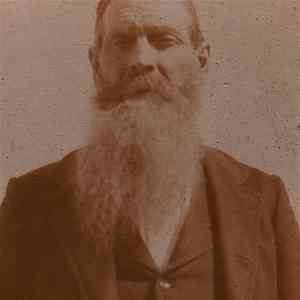
John Eli Scriber (1835-1902)
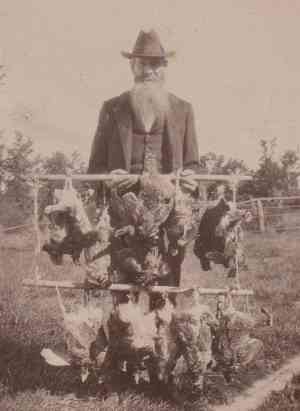
John Eli Scriber with what have been identified as Ruffed
Grouse ... although it says "wild passenger pigeons" (now
extinct) on the back of the photo.
Our thanks to Susan Schock for these biographies and pictures.
|